How We Work
Assess. Plan. Protect. Perform
Four stages, in order. It is the sequence our name is built on and the only sequence that produces a technology environment somebody can be held accountable for.

Why an order
Protection starts with counting what you have
The most common failure in managed services is starting at stage three. A provider is appointed, agents are deployed, tickets start flowing, and eighteen months later somebody asks a question — how many servers do we have, when does that contract expire, has a restore ever been tested — that nobody can answer.
It is a sequence problem. Protection deployed onto an environment nobody has inventoried protects the parts that happened to be visible.
So we start by counting. Every asset, identity, licence, contract and control. It is unglamorous, and everything afterwards depends on it.
The Four Stages
What each stage produces
Every stage ends in a document, and that document is the proof the stage happened.
01 · Assess · Fixed fee
We inventory every asset, identity, licence, contract and control. We test your backups by restoring from them. We score you against the Essential Eight. We interview the people who run the systems and the people who use them. You receive: a written position on your environment, an Essential Eight maturity score with the finding behind each result, a risk register, and a prioritised list of what we would fix first. Yours to keep.
02 · Plan
Findings become a costed, sequenced roadmap. Each item carries an effort estimate, a licence cost where one applies, a business impact rating, and the consequence of deferring it. Split into this quarter, this financial year, and what needs a capital decision. You receive: a three-year roadmap, an annual budget you can take to a board, and a fixed-price proposal for the services you have chosen, with the services we consider unnecessary marked as such.
03 · Protect · Four to twelve weeks
Transition and uplift, run in parallel with your incumbent so the cutover is independent of their goodwill. Monitoring and backup are verified on our side before the service desk cuts over. Controls are staged with pilot groups and documented rollbacks. You receive: a documented environment, an updated control register, a tested backup and restore position, and a written incident response plan with real names and phone numbers in it.
04 · Perform · Ongoing
Steady state. Service desk, monitoring, patching, detection and response, and a reporting rhythm that arrives on a fixed schedule. The roadmap is revised each quarter against what actually happened. You receive: a monthly service and security report, a quarterly business review with your leadership, and an annual reassessment against the Essential Eight so the score is earned again every year.

Onboarding
The first ninety days, week by week
Transitions go wrong in predictable places. This is how we sequence it so the risky parts happen while your incumbent is still contracted.
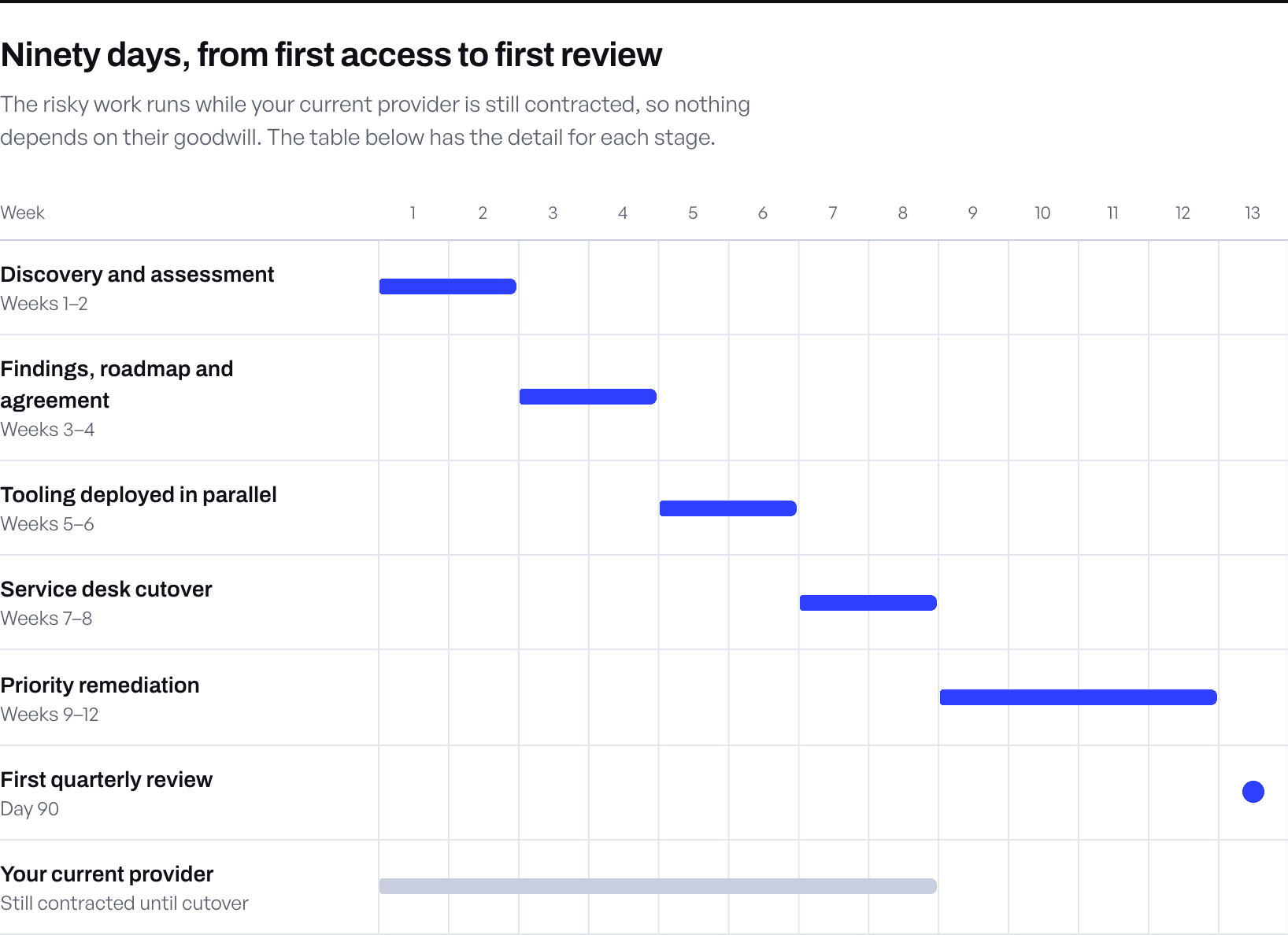
Weeks 1–2
Discovery and assessment. Read-only access to your environment, asset and identity inventory, backup restore test, Essential Eight scoring, staff interviews.
Provide access, introduce us to your key people, and tell us what annoys you most.
Weeks 3–4
Findings presented, roadmap and budget drafted, service agreement finalised, containment authority and escalation contacts agreed.
Review the findings, set the target maturity level, sign or walk away.
Weeks 5–6
Tooling deployed in parallel: monitoring agents, EDR, backup. Documentation built. Your incumbent remains live throughout.
Give notice to your existing provider at a time of your choosing.
Weeks 7–8
Service desk cutover. Staff communication, portal access, a short how-to-log-a-ticket session, and an on-site presence for the first days.
Tell your people. We provide the wording.
Weeks 9–12
Priority remediation from the roadmap: MFA gaps, patching backlog, backup coverage, local administrator rights, and anything rated critical.
Approve the change windows and the two or three decisions only you can make.
Day 90
First quarterly business review: what we found, what we fixed, what moved on the maturity score, and what is next.
Ninety minutes with your leadership team.
In writing
Six commitments, and how you can hold us to them
Every one of these appears in the agreement. A commitment that only exists on a website is marketing.
01
We report honestly, including when it is our fault. Response times we missed, failed restore tests and incidents we could have prevented appear in your monthly report.
02
We tell you what you can skip. Every roadmap includes items marked as deferrable or unnecessary, with reasons.
03
Your data and documentation are yours. Exported on request, in a usable format, at any point during the agreement and at termination.
04
Your tenants and licences stay in your name. We hold delegated access you can revoke yourself in under a minute.
05
Exit assistance is priced before you sign. Documentation handover, admin transfer, agent removal and knowledge transfer, at a rate agreed at the start.
06
Twelve months, then month to month. If we stop earning it, leaving should be a straightforward decision.
Start where everyone starts
A fixed fee and a written position on your environment. What happens next is your call.